Digital Transformation: Where Most Companies Go Wrong
Every few years, a buzzword takes over the business world. Right now, that word is digital transformation. You hear it in boardrooms, read it in company reports, and see it plastered across consulting firm websites. But here is the honest truth — most companies that attempt digital transformation either fail outright or end up with results far below what they expected.
This is not because digital transformation is impossible. It is because most companies approach it the wrong way. In this post, we are going to break down exactly what digital transformation means, why so many companies get it wrong, and what you can do to make sure your organisation is one of the ones that gets it right.
First, What Does Digital Transformation Actually Mean?
Before we talk about mistakes, let us make sure we are on the same page about what digital transformation actually is — because a lot of the confusion starts right here.
Digital transformation is the process of using technology to fundamentally change how your business operates and delivers value to customers. Notice the word fundamentally. This is not about buying new software or moving your files to the cloud. It is about rethinking your entire way of doing business — your processes, your culture, your customer experience — and using technology as the engine that powers that change.
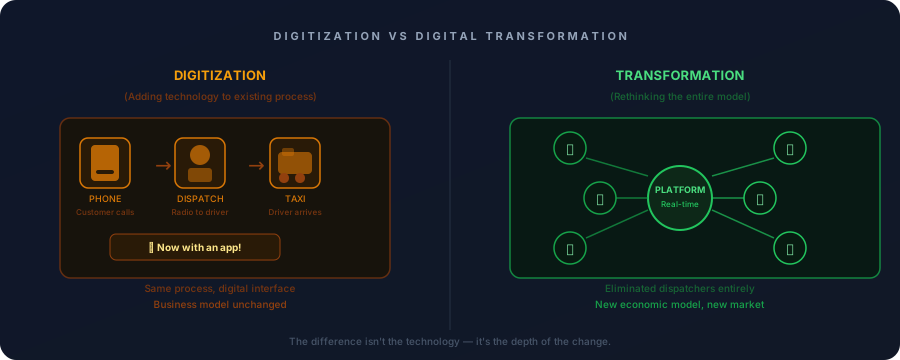
Think of it this way. A taxi company that builds an app to book rides has digitised a process. A company like Uber that used technology to completely reinvent how people move around cities — that is digital transformation. The difference is not the technology itself. It is the depth of the change.
With that definition in mind, let us look at where companies go wrong.
Mistake #1: Treating It as a Technology Project
This is the single biggest mistake, and it is incredibly common. A company decides it wants to digitally transform, so it hands the project to the IT department and says, “Go figure it out.” The IT team buys new tools, upgrades systems, and reports back that the transformation is complete.
But nothing has really changed. Employees are still working the same way. Customers are still having the same experience. The business is not growing any faster. The only difference is that the company now has a bigger technology bill.
Here is the reality: digital transformation is a business project that uses technology, not a technology project that affects the business. The difference sounds small, but it changes everything about how you approach it.
When it is treated as a business project, the CEO and senior leadership are involved from day one. Decisions are made based on business outcomes — how do we serve customers better, how do we reduce costs, how do we move faster? Technology is chosen to support those outcomes, not the other way around.
When it is treated as a technology project, the business leaders check in occasionally, approve budgets, and wait for results. The technology team makes decisions in isolation, often choosing tools they are familiar with rather than tools that solve the actual business problem.
Key takeaway: Digital transformation must be led from the top. If your CEO is not personally invested in the outcome, the initiative will struggle to create real change.
Mistake #2: Ignoring the People Side
Technology does not transform businesses. People do. Yet most digital transformation plans spend 90% of their budget on software and hardware, and almost nothing on the people who will actually use those tools every day.
Think about what happens when a company rolls out a new system. Employees who have been doing their jobs a certain way for years are suddenly told to do everything differently. Some of them are excited. But many are confused, frustrated, or quietly resistant. They find workarounds. They stick to the old way whenever they can. And slowly, the new system becomes just another tool that nobody really uses properly.
This is called change resistance, and it is completely normal. Human beings are creatures of habit. We do not like change, especially when it feels like it is being done to us rather than with us.
The companies that succeed at digital transformation treat their employees as partners in the process. They involve staff early, explain the reasons behind the changes, provide proper training, and create space for feedback. They celebrate small wins and acknowledge when things are hard.
They also pay attention to culture. A company with a culture of fear — where people are punished for mistakes — will struggle to adopt new ways of working. Digital transformation requires experimentation, and experimentation means sometimes getting things wrong. If your culture does not allow for that, the transformation will stall.
Key takeaway: Budget for people, not just technology. Training, communication, and change management are not optional extras — they are core to whether your transformation succeeds or fails.
Mistake #3: Trying to Do Everything at Once
Digital transformation is exciting. Once a company commits to it, there is often a rush of energy and ambition. Leaders start listing everything they want to change — the customer portal, the internal systems, the supply chain, the data infrastructure, the mobile app. Before long, there is a massive list of projects all running at the same time.
This is a recipe for disaster.
When you try to change everything at once, you spread your resources too thin. Teams are pulled in multiple directions. Nobody has enough time to do any single thing properly. Projects start to slip. Budgets overrun. People get burned out. And because everything is connected, a delay in one area creates delays everywhere else.
The companies that do this well take a different approach. They identify the one or two areas where digital transformation will have the biggest impact, and they focus there first. They move fast, deliver results, and use those early wins to build momentum and confidence for the next phase.
This is sometimes called a phased approach, and it works for a simple reason: it is much easier to transform one part of a business well than to transform the whole business poorly.
A good way to decide where to start is to ask: where is the biggest pain point for our customers right now? Or: where are we losing the most time or money because of outdated processes? Start there. Fix that. Then move on.
Key takeaway: Pick your battles. A focused transformation that delivers real results in one area is worth far more than a sprawling initiative that delivers mediocre results everywhere.
Mistake #4: No Clear Goals or Metrics
“We want to be more digital.” This is not a goal. It is a wish. And yet, many companies launch digital transformation initiatives with nothing more specific than this to guide them.
Without clear goals, you cannot make good decisions. You cannot tell whether you are making progress. You cannot know when you have succeeded. And when things get difficult — which they always do — you have no anchor to hold onto.
Good goals for a digital transformation initiative are specific and measurable. Here are some examples of what that looks like in practice:
- ✦Reduce customer onboarding time from 5 days to 24 hours within 12 months.
- ✦Increase the percentage of orders processed without manual intervention from 40% to 85% by Q3.
- ✦Cut the time it takes to generate monthly financial reports from 3 days to 4 hours.
- ✦Achieve a customer satisfaction score of 4.5 out of 5 on the new digital platform within 6 months of launch.
Notice how each of these goals has a number, a timeframe, and a clear connection to something that matters to the business. That is what a good goal looks like.
Once you have your goals, you need to track them. Set up regular check-ins — monthly at minimum — where you review the numbers and ask honest questions. Are we on track? If not, why not? What needs to change?
Key takeaway: Define success before you start. If you cannot measure it, you cannot manage it — and you will not know whether your transformation is working until it is too late to course-correct.
Mistake #5: Choosing Tools Before Understanding Problems
Technology vendors are very good at selling. They will show you impressive demos, share case studies from companies just like yours, and make their product sound like the answer to every problem you have ever had. And sometimes, companies get so excited by the technology that they buy it before they have clearly defined what problem they are trying to solve.
This leads to a situation that is painfully common: a company spends a significant amount of money on a platform, spends months implementing it, and then realises that it does not actually fit the way their business works. Now they are stuck. They have invested too much to walk away, but the tool is not delivering the value they expected.
The right order is always: problem first, solution second.
Start by mapping out your current processes in detail. Where are the bottlenecks? Where do things fall through the cracks? Where are people doing repetitive manual work that could be automated? Where are customers getting frustrated?
Once you have a clear picture of the problem, you can evaluate technology solutions against that specific problem. You will ask better questions during demos. You will spot when a vendor is overselling. And you will make a much better decision about which tool is actually right for your situation.
Key takeaway: Fall in love with your problem, not a particular technology. The best tool is the one that solves your specific problem — not the most popular one or the most expensive one.
Mistake #6: Underestimating the Time and Cost
Digital transformation takes longer and costs more than almost everyone expects. This is not a pessimistic view — it is just the reality of changing complex systems and human behaviour at the same time.
Companies often build their business cases on optimistic timelines and conservative cost estimates. When reality does not match those projections — and it rarely does — leadership loses confidence, budgets get cut, and the initiative loses momentum.
A more honest approach is to build in buffers from the start. If you think a project will take six months, plan for nine. If you think it will cost a certain amount, add 30% for unexpected challenges. This is not being negative — it is being realistic, and it protects the initiative from being derailed by the inevitable surprises.
It also helps to think in terms of total cost of ownership, not just the upfront cost. A new platform might have a reasonable licence fee, but what about the cost of implementation, training, ongoing maintenance, and future upgrades? When you add all of that up, the real cost is often two or three times the initial quote.
What Success Actually Looks Like
After all these warnings, it is worth taking a moment to talk about what digital transformation looks like when it goes right — because it absolutely can go right, and the results can be remarkable.
Successful digital transformation looks like a bank that used to take two weeks to approve a loan now doing it in 24 hours, because they rebuilt their underwriting process around data and automation. It looks like a retailer that used to manage inventory with spreadsheets now having real-time visibility across hundreds of locations, reducing stockouts by 60%. It looks like a hospital that used to lose patient records in paper files now having every piece of information instantly accessible to every doctor who needs it.
In every one of these cases, the technology was important. But what made the difference was the clarity of purpose, the commitment of leadership, the involvement of the people doing the work, and the discipline to stay focused on outcomes rather than getting distracted by the technology itself.
How to Start the Right Way
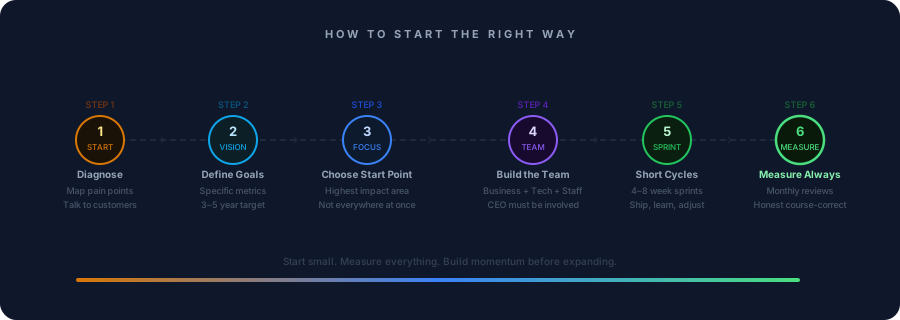
If you are thinking about embarking on a digital transformation journey, here is a simple framework to get started on the right foot:
- 1.Start with a diagnosis. Before you plan anything, spend time understanding where your business is today. Talk to your customers. Talk to your employees. Map your key processes. Identify the biggest pain points and opportunities.
- 2.Define your vision. Where do you want to be in three to five years? What does success look like? Be specific. Write it down. Share it with your team.
- 3.Choose your starting point. Based on your diagnosis, identify the one area where transformation will have the biggest impact. Start there.
- 4.Build the right team. You need business leaders, technology experts, and frontline employees all working together. Do not let this be an IT-only project.
- 5.Move in short cycles. Rather than planning everything upfront and executing over years, work in short sprints of four to eight weeks. Deliver something, learn from it, and adjust.
- 6.Measure relentlessly. Track your goals every month. Be honest about what is working and what is not. Be willing to change course.
Security: The Dimension Most Transformations Ignore
There is one dimension that almost never appears on a digital transformation roadmap but should: security. Every new system you connect, every cloud service you adopt, every employee device you add to the network expands the surface area an attacker can target. Understanding how hackers gain access through credentials and social engineering is not a niche IT concern — it is a foundational element of any responsible transformation. Companies that go digital without getting security right are building on sand.
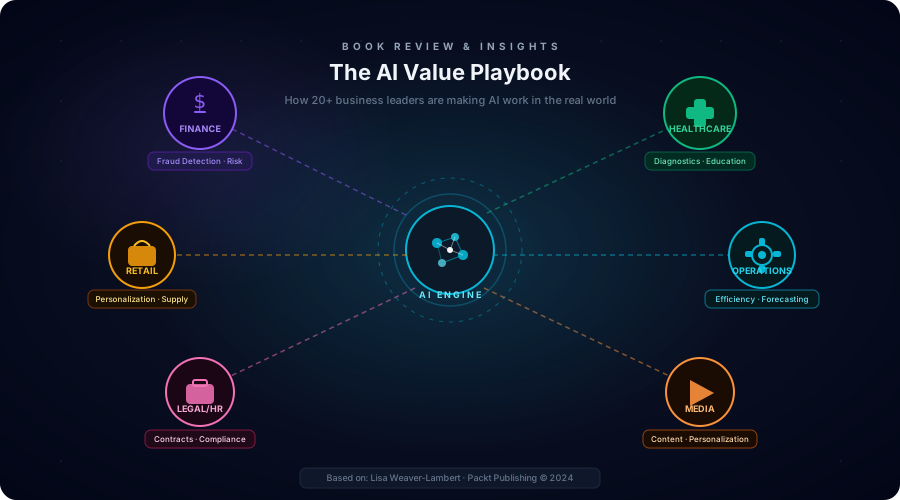
Similarly, AI is now a core part of the transformation toolkit — and understanding how real companies are using AI to drive value will help you separate hype from genuine capability as you build your transformation roadmap.
Conclusion
Digital transformation is one of the most important things a business can do in today's world. The companies that get it right will be faster, more efficient, and better able to serve their customers than those that do not. But getting it right requires more than buying the latest technology.
It requires clear thinking about what you are trying to achieve. It requires leadership that is genuinely committed to change. It requires bringing your people along on the journey. And it requires the discipline to stay focused on outcomes, even when the technology is exciting and the temptation to do everything at once is strong.
The good news is that none of this is mysterious. The mistakes are well-known, and the path to success is clear. The question is whether your organisation has the will to follow it.
At AGEideas, we have helped companies navigate this journey many times. If you are thinking about where to start — or if you are already in the middle of a transformation that is not going as planned — we would love to talk.
Related Articles