
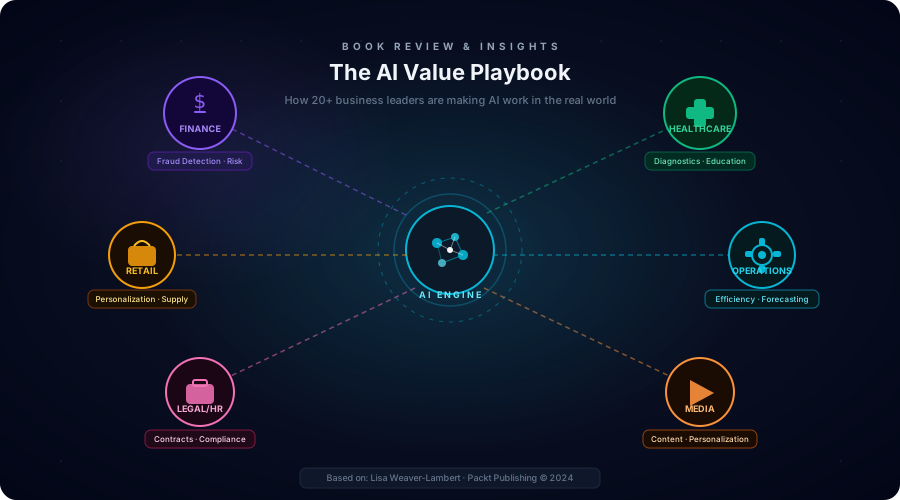
The AI Value Playbook: What 20+ Business Leaders Actually Learned
Let's be real for a second. If you've been anywhere near the internet in the past couple of years, you've heard about AI approximately ten thousand times. ChatGPT this, robot apocalypse that. Your teacher is worried about it. Your parents are confused by it. Some guy on YouTube is claiming it will either save or destroy humanity by Thursday.
But here's the thing: behind all the noise, something genuinely interesting is happening. Real companies — not tech giants in Silicon Valley, but law firms, hospitals, fashion brands, logistics companies, and media outlets — are quietly using AI to change how they work. Some are getting it spectacularly right. A lot are getting it wrong. And a handful of people who've been in the thick of it have stories worth hearing.
That's what this post is about. We're going to dig into The AI Value Playbook by Lisa Weaver-Lambert — a book that interviewed more than 20 executives and data scientists from across industries — and break down what they actually learned. No hype, no panic. Just the honest truth about what AI can and cannot do, why most companies are still struggling to extract value from it, and what any smart person (including you) needs to understand to stay ahead.
Settle in. This one's going to take a minute. Grab a snack.
First: AI Has Been Around Longer Than Your Parents' Phones
Here's something that might surprise you: the term "artificial intelligence" was coined in 1956. That's older than your grandparents' careers. The Dartmouth Conference in the summer of that year is usually cited as AI's official birthday, where a group of researchers sat around and said: "What if we built computers that could think?"
What followed was decades of hype cycles and crashes — periods researchers call "AI winters." Big promises would be made, money would pour in, and then the technology wouldn't deliver. Funding would dry up. Everyone would move on. This happened repeatedly through the 1970s, 80s, and 90s. AI kept getting announced and then quietly dying.
So what changed? Two things: data and computing power. Starting in the 2000s, the internet created an ocean of information — billions of images, sentences, transactions, voices. At the same time, graphics cards originally designed for video games turned out to be insanely good at the kind of math AI needs. Suddenly, models that used to be theoretical could actually run. And then, in 2017, a group of Google researchers published a paper called "Attention Is All You Need," which introduced transformers — the architecture that powers ChatGPT, Gemini, Claude, and basically every large language model you've ever talked to. That paper didn't just improve AI. It started an entirely new era.
The lesson? We are not at the beginning of AI. We are at the beginning of AI that actually works at scale. That's a very different thing.
Breaking Down the Alphabet Soup: ML, DL, GenAI — What's the Difference?
People throw these terms around like everyone went to the same computer science class. They didn't. So let's fix that quickly, because once you understand the layers, everything else makes more sense.
Think of it like a set of Russian nesting dolls:
The biggest doll is Artificial Intelligence — the broad idea of machines doing things that used to require human intelligence. Understanding language, recognising faces, making decisions.
Inside that is Machine Learning (ML) — a specific approach where instead of programming every rule by hand, you feed the computer examples and let it figure out the patterns. You show it thousands of pictures of cats and thousands of pictures of dogs, and it learns the difference. No one ever told it "cats have pointy ears." It figured that out from the data.
Inside ML is Deep Learning (DL) — a technique that uses layers of artificial neurons (inspired very loosely by how brain cells connect). Deep learning is great at complex tasks: understanding speech, translating languages, recognising objects in images. The catch? It's almost impossible to explain why it made a particular decision. It's a black box. That's a real problem in situations where you need to justify a decision — like denying someone a loan.
And nested inside deep learning is Generative AI (GenAI) — the stuff that's blowing people's minds right now. This is AI that doesn't just classify things or predict numbers. It creates. It writes essays, generates images, produces code, makes videos. The big models — GPT-4, Gemini, Claude, LLaMA — are called Large Language Models, or LLMs. They were trained on enormous amounts of text and learned the statistical patterns of human language well enough to produce eerily convincing output.
One important caveat the book stresses: LLMs do not retrieve information from a database and give you guaranteed-accurate facts. They generate what is statistically likely to be correct based on patterns in their training data. This is why they sometimes confidently say things that are completely wrong. In AI-speak, those wrong-but-confident answers are called hallucinations — and they are one of the most important limitations to understand before deploying any of this stuff in a serious context.
The Uncomfortable Truth: AI Has Huge Limitations
Anyone who tells you AI is perfect has either never used it seriously or is trying to sell you something. Lisa Weaver-Lambert's book is admirably honest about what current AI systems cannot do well. Here's the list that matters:
Hallucinations. As mentioned — AI can confidently generate false information. This is not a bug that will be patched next Tuesday. It's a fundamental property of how these models work. Any serious deployment needs a human checking the output.
Bias. AI learns from human-generated data. Human-generated data contains human prejudices — racial bias, gender bias, age bias. If you train a hiring model on decades of employment decisions made by a workforce that was predominantly male, the model may learn to prefer male candidates, even if you never told it gender was a variable. These biases can be subtle, and they can cause real harm to real people.
Explainability. With deep learning, you often cannot trace why the model made a specific decision. It just did. In regulated industries like banking or healthcare, you often need to be able to explain your reasoning. "The AI said so" is not an acceptable answer when someone is denied health insurance.
Scalability costs. Running large AI models at scale is expensive. Training a frontier model can cost tens of millions of dollars. Running inference (actually using the model to answer questions) for millions of users adds up fast. The economics of AI are still being figured out.
Data quality. This one keeps coming up in every interview in the book, so let's put it in bold: without good data, there is no good AI. You can't train a model on messy, incomplete, or wrong data and expect it to produce accurate results. "Garbage in, garbage out" is not a metaphor. It is the number-one cause of failed AI projects.
The Gap Between What People Think AI Does and What It Actually Does
The book opens with a sharp observation: companies like Amazon, Google, Netflix, and Apple have spent a decade building AI into the core of how they operate. Their recommendation engines, fraud detection systems, and content algorithms are not recent bolt-ons. They are foundational infrastructure. These companies were built on data.
But when regular companies — hospitals, banks, retailers, manufacturers — watch those tech giants and think "we just need to flip a switch and AI will do that for us," they run into something called the Solow Paradox.
In 1987, economist Robert Solow wrote: "You can see the computer age everywhere except in the productivity statistics." Computers were everywhere. But productivity gains weren't showing up in the numbers yet. Why? Because it takes time for organisations to learn how to actually use a new technology — to redesign processes, train people, and integrate systems. The productivity gains from computers eventually came, massively, in the 1990s. But there was a 20-year lag.
We are in that lag right now with AI. The technology exists. The value isn't flowing yet — not for most organisations. Why? Because extracting value from AI is hard, and it's mostly a people and process problem, not a technology problem.
Goldman Sachs estimates AI could boost global GDP by 7% — almost $7 trillion — over the next decade. That's an enormous number. But that value won't appear automatically. It requires organisations to do the work of actually integrating AI well. And that's where most of them are stumbling.
Real Companies. Real Stories. Real Lessons.
What makes this book genuinely different is that instead of abstract frameworks, Weaver-Lambert sat down with the people actually in the trenches — CEOs, chief data officers, AI scientists, product leaders — and asked them what really happened. Here are some of the most interesting stories.
Sam Liang, CEO of Otter.ai: "99.9% of human conversations have never been captured."
Sam Liang built the back-end for Google Maps before founding Otter.ai, a company that uses AI to transcribe, summarise, and make searchable the conversations that happen in meetings.
His insight is deceptively simple: humans have been talking for 100,000 years, but most of that knowledge has vanished. Only since Thomas Edison invented the audio recorder have we been able to capture voice — and even then, the vast majority of conversations are never recorded. Every meeting, every brainstorm, every "quick call" is knowledge that evaporates.
Otter.ai changes that. In one case study, they worked with a US-based IT company where sales reps spent a huge portion of their time manually taking notes during customer calls and then re-typing those notes into a CRM system. Otter automated the entire thing — listening with permission, transcribing in real-time, extracting action items, and pushing key information directly to the CRM. The result: sales reps got back roughly one-third of their time. That's not a marginal efficiency gain. That's transformational.
They also worked with a global financial media company to help journalists cover stories faster and to make meetings more inclusive for employees with hearing impairments. AI doesn't just save time — it can open doors that were previously closed.
Sam's vision for where this goes next? AI models that can eventually participate in meetings themselves — not just transcribe, but identify the most important topics, flag decisions, and provide context. "Quite fascinating, isn't it?" he says. It really is.
Amr Awadallah, Founder and CEO of Vectara: The Moment Everything Changed
Amr Awadallah built Cloudera — a $5 billion big data company — before starting Vectara, a platform that helps businesses harness generative AI using their own proprietary data.
He has a brilliant way of explaining why generative AI is a genuinely different moment in history — not just another incremental improvement.
Think about how we've interacted with computers over time:
In the beginning, you had to type exact commands into a command line. "ls -la /home/user" or you got nothing. Only a tiny percentage of people knew how to do this. Computers were a specialist tool.
Then Windows 95 came along with menus, icons, and a mouse. Suddenly, millions of people who had never programmed could use a computer. You pointed and clicked. Interface was democratised. But every existing piece of software had to be rewritten to support this new way of interacting.
Then the iPhone. Touch screens opened computing to everyone — children, grandparents, people in remote villages with no prior tech experience. The interface became as natural as using your hands. Again, every app had to be rebuilt for this new paradigm.
Generative AI is the next leap. You don't click, swipe, or type commands. You just talk — or type in plain human language — and the system figures out what to do. "What was the main competitor mentioned in my last three sales calls?" "Draft a response to this complaint in a warm but professional tone." "Summarise these 40 contracts and flag any unusual clauses."
The enormous implication: every single piece of software will need to be rebuilt for this interaction model. That's not hyperbole — it's the trajectory Amr sees coming. And it represents both a massive business disruption and a massive opportunity for people who position themselves well.
Amr's take on AI and jobs cuts right to the fear most people carry but rarely say out loud:
"The fear of job loss is not because of AI — it's because of those who know how to use AI versus those who don't. Those of us who know how to embrace it and leverage it will be 100 times more productive in everything we do. And those of us who don't will fall behind."
That's the honest truth. Some roles — particularly those that involve repetitive, rules-based tasks — will be automated. Call centre agents handling scripted queries. Some aspects of data entry. Certain driving jobs. These changes will happen gradually, then suddenly.
But for most people in most jobs? The story is not replacement. It's leverage. The people who learn to use AI well will do in an hour what used to take a week. Lawyers who use AI can review contracts 100x faster. Developers who use AI can write code more fluently. Marketers can produce better campaigns with smaller teams. The skill being rewarded is not "can you do this task" — it's "can you use AI to do this task better and faster than the next person?"
Zeev Farbman, CEO of Lightricks: When AI Writes the Code
Zeev Farbman co-founded Lightricks, the company behind apps like Facetune, Videoleap, and Photoleap — tools downloaded more than 680 million times. His insight comes from watching AI change the very act of writing software.
For decades, building software required knowing a programming language. Code was a specialist language that only trained engineers could write. That gatekeeping is starting to dissolve. Large Language Models have reached a point where they can generate high-quality code from natural language descriptions. Lightricks started seeing projects where "most of the code is written by AI." A cybersecurity startup told him that 95% of their first product was built using LLMs.
What does Zeev recommend for leaders navigating this? Get close to the technology. Don't delegate your AI understanding to someone else. He went back to programming himself — as a CEO — to understand what AI could actually do. "The only way to make the most of these incredible advancements in AI is to dive in and ask the hard questions," he says.
His three-phase approach for businesses is elegant: Engage (really understand what AI can do), Adapt (change your operations and product accordingly), Innovate (find new opportunities that only AI unlocks). Most businesses are still stuck in phase one.
The AIVP Framework: A Four-Part Playbook for Doing This Right
After interviewing over 20 practitioners and compiling case studies across industries, Weaver-Lambert distilled everything into what she calls the AI Value Playbook framework — four interconnected components that determine whether an AI project succeeds or fails.
Here they are, plain and simple:
1. Strategic Alignment — Start With the Problem, Not the Technology
This sounds obvious. It is not practised nearly enough.
The most common mistake organisations make is going "we have a load of data, now what do we do with AI?" That is backwards. The right question is: "What is the most important problem in our business right now, and can AI help us solve it?"
AI that isn't aligned with a clear business objective is just an expensive science project. Every person interviewed in the book stressed some version of this. Start with the problem. Quantify it. Understand who owns it. Then — and only then — figure out if AI is the right tool.
The book also makes an important observation: the value of an AI solution depends on who is invested in using it. Technical teams often build AI tools that the business side never adopts because they were never properly consulted. Ownership of an AI project needs to sit with the business unit that experiences the problem — not just the data scientists.
2. Technical Capability — Your Data Has to Be Ready First
Here is the unsexy truth that every executive needs to hear: most AI projects fail before they start because the data isn't ready.
"Without data, there is no AI." That sentence appears, in different forms, in basically every interview in the book. Before you can build a meaningful AI solution, you need data that is:
- Accessible — not trapped in five different legacy systems that don't talk to each other.
- Clean — accurate, not full of duplicates, errors, and inconsistencies.
- Structured — in a format an AI system can actually process.
- Sufficient — enough examples to actually train or fine-tune a meaningful model.
In many established companies, the majority of time and effort on an AI project goes not to the model itself, but to getting the data foundation right. Practitioners in the book estimate that 70-80% of an AI project's effort is data work. The glamorous model training and deployment is the last 20%.
One concept from the book worth knowing: RAG (Retrieval Augmented Generation). Instead of training a model on your company's data (which is expensive and technically complex), RAG lets you keep your data in a separate, searchable store, and the AI retrieves the relevant facts before generating an answer. The model has general language intelligence; your data provides the specific facts. This significantly reduces hallucinations and is often the faster, cheaper, and more accurate path for business use cases.
3. Operating Model — AI Is a People Change, Not Just a Tech Change
This one trips up smart companies all the time. You can deploy the world's best AI tool and have it go nowhere if the operating model around it isn't right.
The operating model is the answer to: how will this actually work in practice? Who uses the tool? How are they trained? What processes change? Who is accountable for the outputs? How do you handle it when the AI gets something wrong?
Lightricks learned this first-hand. When they started integrating AI into their development workflow, early enthusiasm from leadership didn't immediately spread through the organisation. Some teams were resistant. Early AI features didn't all land well with customers. There was friction. Their solution was gradual adoption — giving every employee access to the latest tools, finding early adopters for pilot projects, developing clear guidelines (including from the legal team) about what AI use was acceptable in different contexts.
The pattern holds across companies: AI doesn't work unless people trust it, understand it, and have clear guidance on when and how to use it.
4. AI Adoption and Managing Change — The Human Side Is the Hard Side
The final component is arguably the most underestimated. Technology changes are straightforward compared to human behaviour changes.
Introducing AI into a workplace means changing how people spend their time, what skills matter, and sometimes what certain roles look like. Some people will feel threatened. Others will be enthusiastic early adopters. Most will be cautiously curious but quick to disengage if the tool doesn't deliver value fast.
The book emphasises that successful AI adoption requires:
- Internal training — people need to know how to use the tools, and crucially, they need to understand their limitations. Over-trusting AI output is as dangerous as not using it at all.
- Addressing resistance honestly — if people are worried about their jobs, ignoring that concern doesn't make it go away. Leaders need to communicate clearly about what AI will and won't change.
- Measuring what changes — you can't manage what you don't measure. Every AI initiative should have clear metrics: time saved, error rate reduced, revenue generated, costs cut.
- Continuous adjustment — AI systems are not "set and forget." Models drift as the world changes. Business needs evolve. The best AI implementations treat deployment as the start of the work, not the end.
Case Studies Worth Knowing
Beyond the executive interviews, the book includes a set of detailed case studies that show AI applied to specific real-world problems. Here are a few that stand out:
Personalised Education for Healthcare Technicians Using LLMs and RAG
Healthcare technicians need to stay current on complex, rapidly-changing knowledge — procedures, regulations, equipment. Traditional training is one-size-fits-all and quickly becomes outdated. This case study explored using LLMs combined with RAG to provide hyper-personalised educational content. Instead of a generic module, each technician could ask questions in natural language and receive accurate, sourced answers matched to their specific role and level of experience. The result was faster knowledge transfer and higher retention — AI as a patient, infinitely available tutor that always cites its sources.
AI-Powered Virtual Agents in Customer Service
A common misconception is that AI customer service means cold, robotic chatbots that frustrate everyone. This case study showed a different approach: AI virtual agents handling the high-volume, straightforward queries (account balance, delivery status, password reset), while routing complex or emotionally sensitive cases to human agents. The result was that human agents got to spend their time on cases that genuinely needed human empathy and judgement — which is also more satisfying work. AI and humans collaborating, each doing what they're actually good at.
Minimising Customer Churn With AI
Customer churn — the rate at which customers stop using a service — is one of the most expensive problems in business. Acquiring a new customer typically costs five to seven times more than retaining an existing one. This case study showed how AI models trained on customer behaviour data (usage patterns, support interactions, billing events) could predict which customers were likely to cancel weeks before they actually did — giving the business a window to intervene with targeted offers or personal outreach. The economics were compelling: a relatively modest improvement in churn prediction translated to significant revenue preservation.
AI Driving Innovation in Marketing
One of the most underappreciated applications is AI in creative work. A case study on marketing showed how LLMs could generate and test dramatically more variations of ad copy, email subject lines, and audience targeting approaches than any human team could produce manually. A/B testing at AI-scale — where you're testing hundreds of variants simultaneously instead of two — produced measurable improvements in campaign performance. Crucially, the human marketers weren't replaced; they were elevated to the role of strategists and judges, reviewing the best outputs and guiding the direction, rather than manually writing every variation themselves.
What Does Trustworthy AI Actually Mean?
The book spends meaningful time on a concept that is easy to dismiss as corporate jargon but is increasingly important: responsible, trustworthy AI.
As AI makes more decisions that affect people's lives — who gets a loan, who gets called back for a job interview, what price you're shown for a flight — questions of fairness, accountability, and transparency become urgent. Trustworthy AI is an approach to building systems that are:
- Transparent — you can understand, at least broadly, why they produce the outputs they do.
- Privacy-respecting — they handle personal data responsibly and in compliance with regulations like GDPR.
- Fair — they don't systematically disadvantage protected groups.
- Reliable — they work consistently and fail safely.
- Auditable — someone can review the system's behaviour and hold it accountable.
This isn't just an ethical nice-to-have. As governments around the world start regulating AI (the EU AI Act is already law), organisations that haven't built trustworthy practices into their systems from the start will face costly retrofits. Building it right from day one is cheaper and smarter.
The Copyright Problem Nobody Has Solved Yet
There's one major unresolved issue the book tackles honestly: copyright.
LLMs were trained on vast amounts of text from the internet — including books, articles, code, and images created by humans who never consented to having their work used as training data, and who have never been compensated for it. Most AI companies argue it's analogous to how humans learn by reading and absorbing everything around them, then producing original-ish work inspired by it. Most authors and artists argue it's something different — and they're suing.
The legal landscape here is genuinely unclear and moving fast. Courts in multiple countries are weighing in. Major publishers have signed licensing deals with some AI companies. Others are fighting in court. As someone building something or creating something professionally, this is a space to watch closely.
Generative AI vs. What Came Before: The Three Waves
One of the clearest explanations in the book comes from Amr Awadallah, who breaks down the history of AI in business into three distinct waves:
Wave 1 — Pattern Recognition. AI that looks for known patterns in historical data. Fraud detection (this transaction looks like past frauds). Medical diagnosis (this X-ray looks like the ones that turned out to be cancer). Quality control in manufacturing. These systems are narrow, very accurate within their domain, and widely deployed.
Wave 2 — Clustering and Personalisation. AI that groups similar things together without being told what categories to look for. Recommendation engines (Netflix: people who watched this also watched that). Customer segmentation. Supply chain optimisation. Pricing algorithms.
Wave 3 — Generative AI. AI that can understand and produce human language, images, code, and video. This is where we are now. It's a milestone not just in capability but in accessibility — for the first time, anyone can interact with AI in plain language, without special training.
Most mature organisations are using a mix of all three. But the generative wave is the one reshaping the interface between humans and software at the most fundamental level.
What This Means for You — Right Now, at Your Age
Okay, let's bring this home. You're a high schooler (or close to it). You're going to spend the next 40 years of your career in an AI-shaped world. What should you actually take from all of this?
Learn to use the tools, not just talk about them
The gap between people who understand AI conceptually and people who use it fluently every day is enormous — and it's closing fast. Start using ChatGPT, Claude, or Gemini for real tasks: drafting emails, researching papers, debugging code, brainstorming. Use image generation tools. Build something with an AI API, even if it's tiny. Practical fluency beats theoretical knowledge every time.
Data is the new foundational skill
Every executive in this book came back to data. Understanding how to collect, clean, interpret, and query data is one of the most transferable skills of the next decade. You don't need to become a data scientist. But basic data literacy — reading a chart critically, understanding what a sample size means, knowing when a statistic is misleading — is now as important as being able to write a coherent paragraph.
Soft skills are not going anywhere
Here's a counterintuitive truth from the book: as AI handles more of the routine cognitive work, the distinctly human skills become more valuable, not less. Creativity. Empathy. Strategic judgement. Ethical reasoning. The ability to ask the right question. The ability to spot when an AI answer is wrong. The ability to communicate across disciplines. These are not skills machines are going to replace in the near term. They're the premium skills of the AI era.
The scary question isn't "will AI take my job" — it's "will I know how to use AI in my job?"
This is Amr's insight, and it's the most useful reframe in the whole book. Stop asking whether AI will replace you. Start asking: am I building the habits and skills to be one of the people who uses AI better than everyone else in my field? In medicine, in law, in teaching, in design, in engineering — the practitioners who will thrive are not the ones who pretend AI doesn't exist, but the ones who learn to harness it thoughtfully and critically.
Curiosity is your competitive advantage
The CEO of Lightricks went back to writing code as a 40-something executive because he needed to understand what AI could actually do. He didn't delegate his understanding. He got in the arena. That curiosity — the willingness to dive in and get your hands dirty with new technology — is not a personality trait some people have and others don't. It's a choice. And right now, in this moment, it is arguably your most valuable asset.
Where Things Go From Here
Weaver-Lambert ends her book with honesty about uncertainty. Nobody knows exactly how fast AI will advance or which industries it will reshape most dramatically. The full impact of AI is yet to materialise, partly because large sectors of the economy are still in the early stages of integration. It will take time. The Solow Paradox suggests we might be in the lag for a while yet.
What is clear is this: the organisations that are winning right now are not the ones with the fanciest models. They are the ones that aligned their AI efforts with real business problems, invested in getting their data right, built cross-functional teams that include business people alongside technologists, and managed the human change with the same seriousness as the technical deployment.
The big-picture message of the book is fundamentally optimistic. AI is not a genie that will do everything for you without effort. It is a genuinely powerful new tool that, like every transformative technology before it — electricity, computers, the internet, smartphones — will reward the people who take the time to understand it deeply and use it wisely.
That time is now. And you're earlier in this shift than you might think.
The Cheat Sheet: Ten Things to Remember
- AI has been around since 1956. What's new is that it actually works at scale, thanks to more data, better hardware, and the transformer architecture.
- LLMs generate what is statistically likely to be correct — they can confidently hallucinate. Always verify important outputs.
- Bias in, bias out. AI inherits the prejudices of the data it was trained on. This is a serious ethical and legal issue.
- The Solow Paradox is real. Technology arrives before productivity does. We are in the lag. But the gains will come.
- Without good data, there is no good AI. Data quality is the number-one cause of failed AI projects.
- RAG (Retrieval Augmented Generation) is often better than fine-tuning for business use cases — more accurate, cheaper, and faster to deploy.
- The fear isn't AI taking your job — it's people who use AI doing your job better than you. Learn the tools.
- Successful AI is a people-and-process challenge as much as a technology one. Change management matters enormously.
- Trustworthy AI — transparent, fair, accountable, private — is not just ethical. It's increasingly a legal requirement and a business advantage.
- The skills that AI cannot easily replicate — creativity, empathy, ethical judgement, strategic thinking — are becoming more valuable, not less.
One Final Thought
There is a quote in the introduction to The AI Value Playbook that I keep coming back to. Weaver-Lambert writes that "incorporating AI is fundamentally about empowering people to do their best work and make the best next decision."
Not replacing people. Empowering them. The framing matters enormously. AI, used well, is a force multiplier for human potential. A doctor who can get an AI second opinion in seconds is a better doctor. A lawyer who can review 500 contracts in an hour instead of a week can take on cases that would otherwise be unaffordable to pursue. A teacher who has an AI that can adapt a lesson to every student's learning style can reach every kid in the classroom.
You are entering the workforce at the most interesting technological moment in a generation. That's not something to fear. It's something to lean into, with curiosity, with rigour, and with a healthy dose of scepticism about the hype.
The AI Value Playbook exists to give people that lens. If anything in this post sparked something for you, the full book is worth your time.